
APM Model
A Systemic approach to employee performance management
Adaptive Performance Management provides a novel approach to managing employee performance, firmly backed by science and experience in the field. Our practices help your organization and your employees thrive in this era of complexity and fast change.
Overview: The Adaptive Performance Management model

Organizations have an increasing need to adapt to fast changing market conditions. As the talent, creativity, and drive of employees are the most important assets an organization has, it is imperative to optimally manage their performance. Sadly, a lack of correlation between performance management systems and business outcomes is a common issue faced by many organizations.
Adaptive Performance Management (APM) is designed to address the shortcomings of traditional performance management systems. It has the following key components:
Employee engagement
The core of APM is employee engagement. Research indicates a strong correlation between employee engagement and business performance. Building and nurturing a workplace that supports engagement is one of the most important leadership tasks.
Core practices
APM has five core practices. These practices are closely related and provide a solid foundation for a better employee performance management system that drives business outcomes as well as happier employees. Additionally, we provide practices that support the core of APM to build an even stronger HR system in your organization.
Employee engagement
Studies show that companies with more engaged employees tend to achieve better business results. As a result, it is crucial for leaders to establish and cultivate a work environment that fosters employee engagement. Note that you cannot directly motivate or engage people. They need to do that themselves. But you can build a workplace that supports engagement. Such a workplace requires the following characteristics:
An engaging workplace needs to support:
Self-Determination Theory identifies three psychological needs that are universal to all individuals. Build a work environment that supports these needs to drive employee engagement.

Autonomy
Everyone feels the need to self-regulate one’s experiences and actions. The feeling to have choices and to wholeheartedly stand behind your actions is a strong motivator.

relatedness
Relatedness means feeling socially connected to others. In organizations, people experience relatedness when they feel able to contribute to their team or the organization.

Competence
Competence is the need to be good at something. The need for competence is most optimally satisfied if one can do challenging work, but within the limits of one’s skills.
An engaging workplace needs to reduce:
Renowned author Patrick Lencioni discovered three obstacles for engagement. To support employee engagement, it is crucial to reduce these obstacles in your organization’s workplace.

Anonymity
People work in an organization, in a department, in a team. They are part of a group of people. But if they do not perceive themselves as belonging to a group, or they think others don’t know them, or see them, understand them, and appreciate them for who they are, they cannot be engaged with their job.
Irrelevance
Irrelevance has to do with knowing your job matters to someone. These can be customers, colleagues, or just your boss. Nothings is more soulless than having the feeling your work is in no way connected to others and means nothing to anyone else.
Immeasurement
Immeasurement relates to the ability to measure your own progress and contribution. People want to feel effective. They want to feel their efforts matter. If you can’t tell how well you are doing to meet your goals, then why bother in the first place. Leaders should help employees asses how to track their own progress.
Five core practices
The five core practices of APM are closely related. It is advised to implement them in the order we list them. Measuring engagement provides the baseline to gauge further progress. Identifying strengths is the start of helping employees use their strengths everyday. Check-in meetings turn judgmental review meetings into coaching attention meetings. Job clarity helps the employees understand how and to whom their jobs matter. And finally, goal setting gets an overhaul to make goals more effective.

1. Measure engagement
It may seem counterintuitive and illogical to some, but instead of measuring individual performance, we propose measuring engagement. There are a number of reasons for this:
- First, performance is a lagging indicator. You can only establish if the goal is met after the fact. Our proposal involves incorporating leading indicators that accurately forecast the intended goal. Research indicates a strong correlation between employee engagement and business performance, which makes engagement a good leading indicator.
- Work today is highly collaborative in nature. Simply measuring the performance of the individual employee against individual targets does not reflect this well. It might even have a negative effect.
Measuring employee engagement can of course reveil important insights to address. But it also functions as a baseline. Regular follow-up pulse surveys provide insight if your renewed performance management practices are headed in the right direction.


2. Asses & support strengths
Performance management is traditionally remedial in nature. We aim to improve shortcomings. But as Einstein said: “if you judge a fish by its ability to climb a tree, it will live its whole life believing it is stupid“. Much better is to identify the unique strengths of your employees and support them to mold their jobs around their strengths.
Using strengths starts with identifying them. There are many tools that can help you identify your strengths, like Gallup’s StrengthFinder tool, Marcus Buckingham’s Standout assessment, and our recommended tool High5.

3. Conduct frequent check-ins
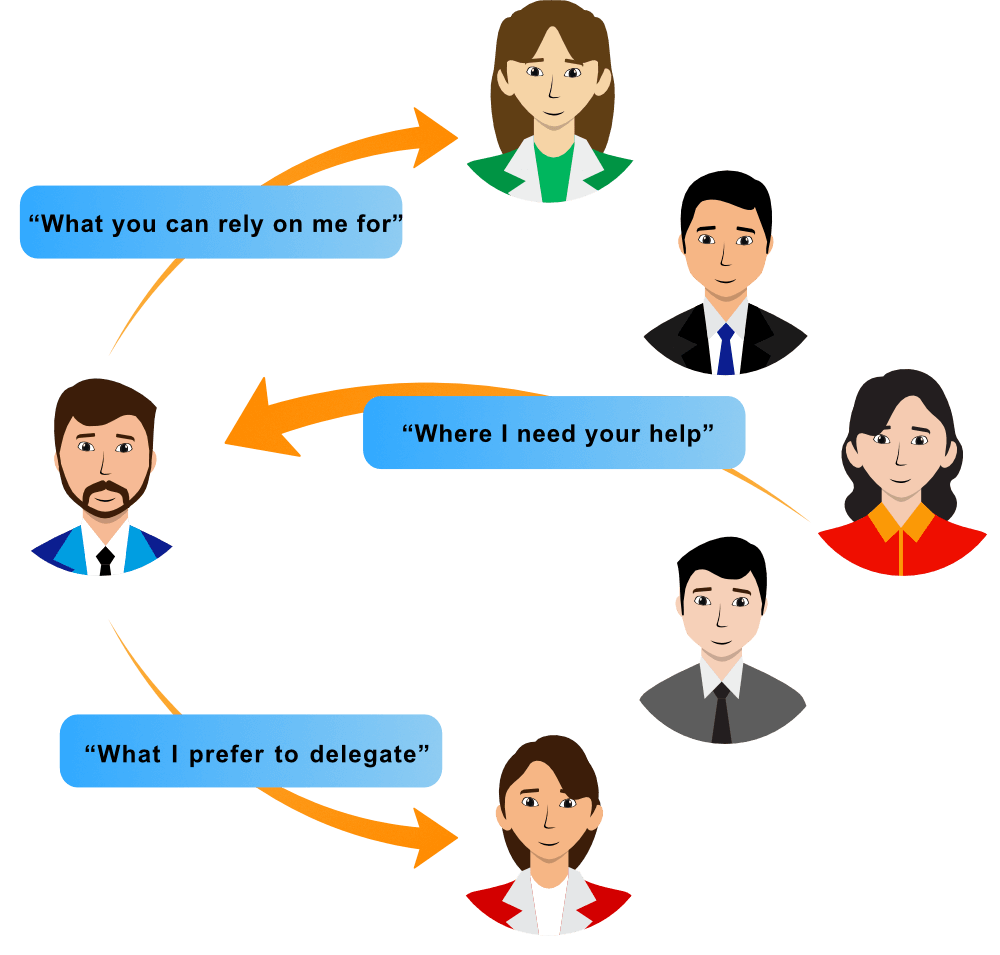
Instead of traditional review meetings one or two times a year, we propose frequent check-in meetings. The check-in meeting is not a feedback meeting. It is not about the opinion of the manager. It is about giving attention and support. It’s about checking in, instead of checking on.
Check-in meetings are short weekly or bi-weekly meetings focusing on last week’s experiences; what the employee is trying to achieve this week; and where help is desired. It ensures focus on near-term work and helps to keep feedback loops short.


4. Provide job clarity
Job Clarity is an important part of setting the right conditions for engagement. If employees understand how their job matters to others, how the outcome of their job contributes to the goals of the company, how they can have control over their own job, and measure the progress of it… if all that is in place you have come a long way in inviting engagement.
Job clarity has several dimensions:
- understanding how to contribute to the goals of the organization
- having control over your own job
- understand how your job matters to others
- being able to measure your own progress


5. Craft goals
Goal setting is still an important part of our revised performance management system.
- Goals help people focus. It is easy to get sidetracked without clear goals. And especially if we give people more autonomy it becomes more important to help them focus on what is really important.
- Goals help people to become more persistent. When you have a goal you are committed to, it can even pull you through a hard day when you are not at your best.
- When goals are well defined they motivate performance even beyond what people thought they would be able to achieve otherwise. Which is motivating in it’s own right.
But the way we define goals needs some tweaking. Setting goals for employees in Adaptive Performance Management has some distinct characteristics: Goals have to be cascading, frequent, self-owned, measurable, selfless, and relevant.

Three support practices
APM’s core practices provide a solid foundation for a revamped employee performance management system. But while you’re at it, there are a few other related practices that are the cherry on top.

Balance Performance and Values aligned behavior
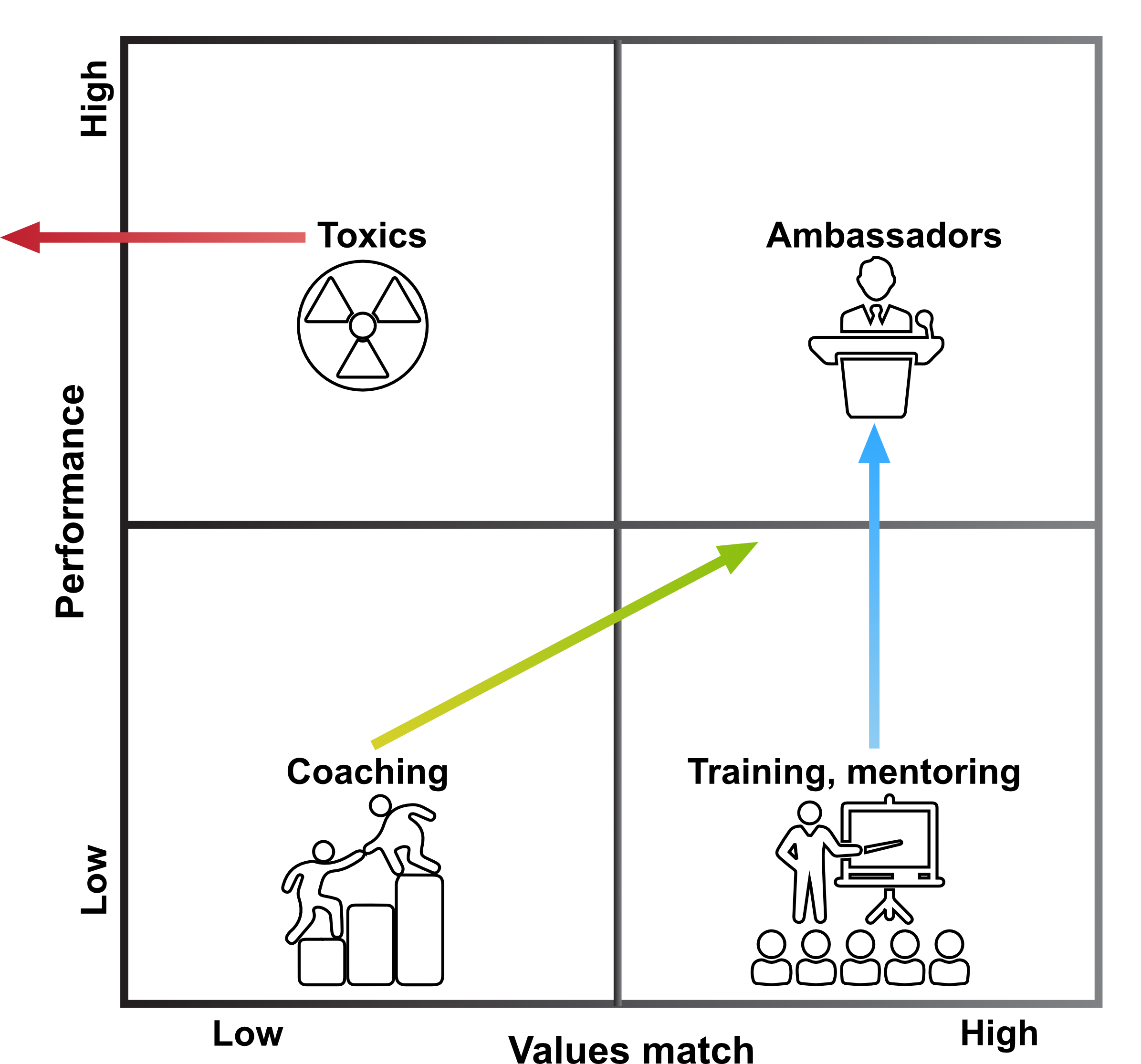
Purpose and core values are an important part of the corporate identity. But this is not without obligation. From now on values aligned behavior matters just as much as hard performance. And this has consequences for performance management too.
Performance and values-aligned behavior need to be carefully balanced.

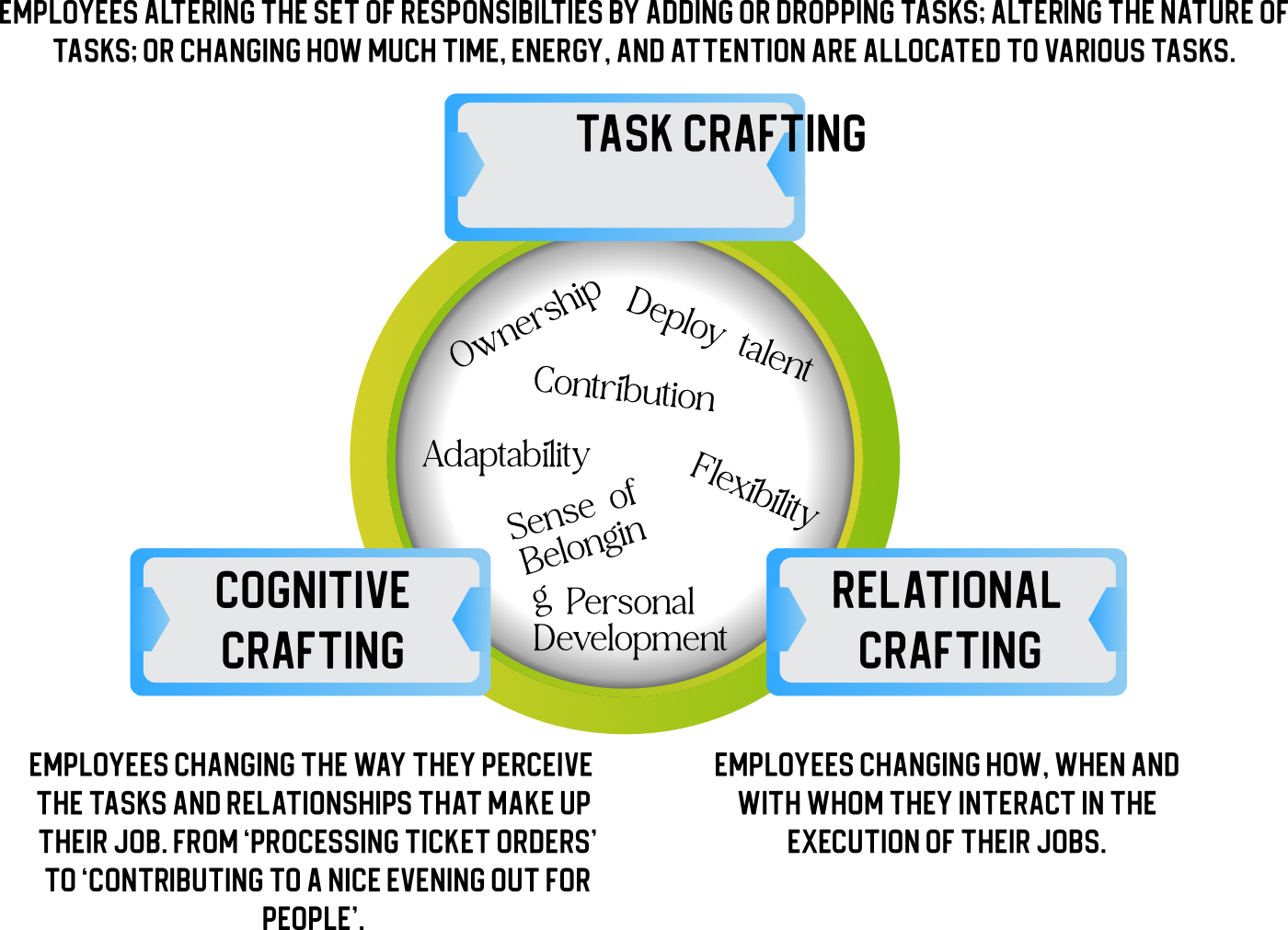
Support Job crafting
Job crafting means the employee changes their job in a way so it better fits their talents and needs. While this is strictly speaking not a manager’s task, it is the responsibility of the manager to coach and support employees in this practice.
Job crafting also supports the three fundamental needs of autonomy, relatedness, and competence.

Create a meritocratic system for pay
In most organizations salary is based on position and rank. And politics get to play a large role in determining one’s position, according to 76 percent of a survey conducted by Hamel & Zanini. All this is in high contrast with other positions in society. For example, an athlete wins a gold medal based on achievements.
In a meritocratic system, one’s pay and influence are determined by merit, the contribution to the goals of the organization. APM provides comprehensive advice how to deal with pay in a way that support motivation and engagement, rather than undermines it.

Curious how your organization is doing?
Take the APM quick scan and get a free report on how your organization stacks up against APM guidelines and practices.
Other relevant information
Why APM?
Understand the need for a redesign of performance management. See if you recognize some of the issues in your organization.
APM guidelines
Discover the guidelines to inspire your endeavor to a fundamental overhaul of employee performance management.
Getting started
Get practical advise where to start. Use our quick scan to get an in-depth analyses of where your organization stands.