During a Management 3.0 training I gave, one of the participants had a question on supporting management towards a change in their role. How can we motivate middle management in particular because for them a management transition towards servant leadership potentially has such a huge impact. The specific question was: “If I am going to loose control by delegating authority, what do I get back for it?”
What can you expect from this article?
- a step by step approach to guiding managers towards servant leadership
- useful tools and tips you can start using right away
The question
A bit of background information: Management 3.0 is a framework that concerns itself with a different way of fulfilling the role of management in organizations. It replaces direct control of people with the creation of an environment in which employees can get motivated, have autonomy, and can learn continuously. The need for this different role of management is twofold: On one side the environment of organizations is changing increasingly fast and is rapidly getting more complex. Traditional management methods do not handle this complicity well. On the other side it simply makes work more fun, which eventually will also lead to better results as is indicated by many studies.
Organizations with a desire to become more adaptive can use Management 3.0 principles to achieve this. For teams and individuals this often has a direct positive impact because they get more autonomy, more chances to take initiative and opportunities to develop themselves. For senior management it is a strategic choice they deem necessary for the success of the company. But for middle management, as I often experience in my consultancy work, this change has the biggest impact. They have to let go of a style of management that has been deeply embedded in the organizations they work for. Suddenly they are expected to adopt practices that feel alien to everything they have ever learned on the subject of management. Many times they have to implement this change while they are still being ‘managed the old way’ themselves. No easy job. In this situation it seems a very relevant question: How can we help the manager in this transition?
A step by step approach
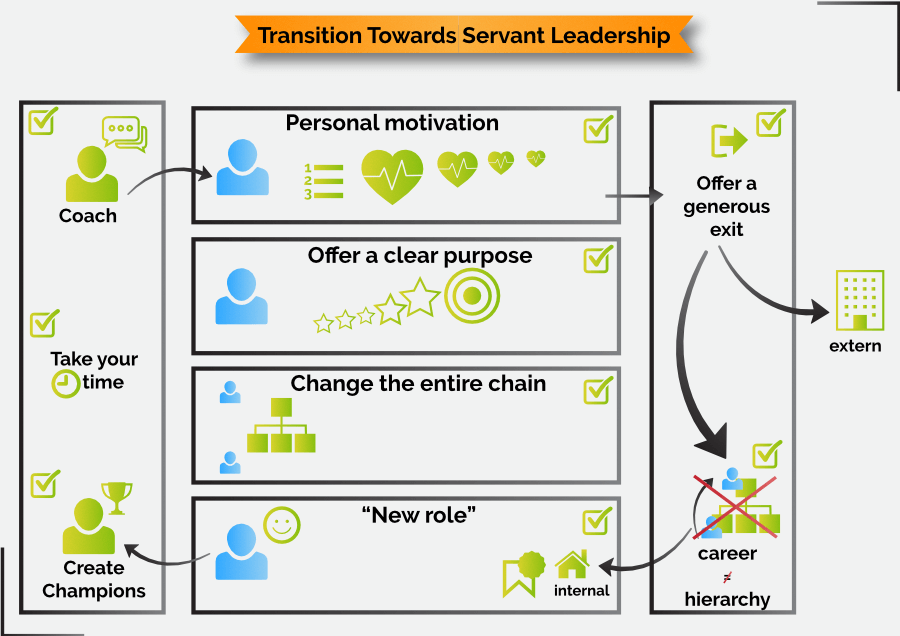
Start with personal motivation
Start with gaining insight in what the person in question truly motivates. A helpful tool for this within the Management 3.0 toolkit is Moving Motivators, which is a set of 10 intrinsic and extrinsic motivators we can use to get an understanding of what matters to someone and gets him going. Some people are motivated by status for example. For others the relationship with coworkers is very important.
So we start with personal motivation. The tool offers a set of cards, one for each of the 10 motivators. Ask the person in question to rank the cards in order of importance. Which motivator is most important for him in his work? Which ones are less important? Having a conversation on the ranking is the real value because then you will discover why some motivators are so important to someone.
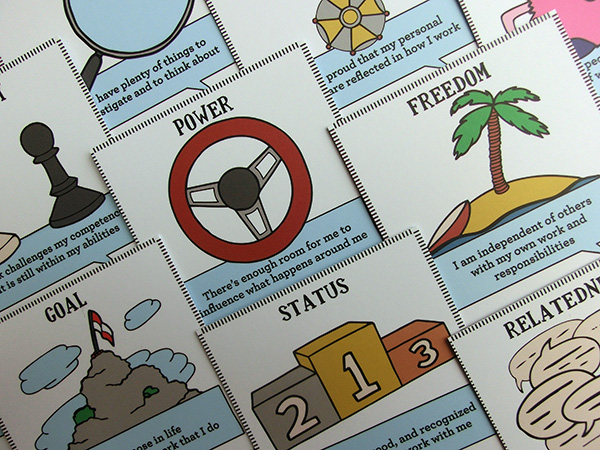
The second step shows whether certain motivators are positively or negatively influenced by someone’s current role. Imagine someone values status. Does the current role fulfill that motivator in a positive or negative way? Ask for actual examples. Move motivator cards that are positively triggered up, and negatively triggered motivators down. This creates a visual image which is another topic of conversation.
Next we investigate the expectations the manager has of his new management role. What does the manager expect to happen with the motivators that matter most to him? Will the motivator be triggered in a positive or negative way?
These steps provide important insights for the manager. I have experienced that a manager expected some motivators to get negatively triggered by her new role, but she also discovered some other motivators that were potentially triggered in a positive way. These are the first topic in coaching. This also touches the second goal of this focus on motivation: it gives the manager the feeling that his personal motivation matters. We are not simply taking something away and give something in return. We go on a journey that fulfills a new role in a way in which personal motivations matters.
Purpose
Dan Pink points out that organizations should spend more time on asking WHY we do something and less on HOW to do the work. He has illustrated this with an example of a research study that was conducted among call center volunteers at a major US University. The call center workers took part in fundraising for scientific research. The researchers divided the workers into three groups: One group spend five minutes of reading letters from former call center workers explaining which personal benefits the work had brought them, before they called. The second group also read letters for five minutes, but this time they were from people that had received funds and explained what valuable research the money was spent on. The third group was a control group and was allowed to spend the five minutes anyway they wanted. The two groups that read letters before calling outperformed the control group by far. But the group that read letters on the impact of the donations raised twice as much money as the other group!

People are motivated by a higher purpose if that purpose is clear and they know how to contribute to it. Even more so if the purpose aligns with their personal goals and values. So don’t start with HOW the new role of management should look like, but start with the question WHY we are changing the role the first place. Be crystal clear on the purpose of the organization and give management the opportunity to align their personal goals with the goals of the organization. Don’t be surprised if some managers get so engaged in the process they look for new ways to fulfill the management role in line with the company purpose by themselves.
Offer a generous exit
Helping managers through a change also means helping them to gain insights whether or not the new role really fits them. Don’t expect everybody to be able or willing to take the journey with you. And that should be ok. If the new role does not trigger any personal motivation positively, you will not be doing that person, or the organization any favor when you force someone into the new role.

It is important to be transparent that the conclusion that a new role does not fit is an acceptable outcome. It is not a personal failure. Offer a generous exit as part of the transition and be very transparent on this upfront. Realize that it is the organization itself that is responsible for the current management style. We created the type of managers we know expect to change in a way that differs fundamentally from anything they were ever taught on management. So senior leaders must take responsibility for anyone that cannot follow in this change.
What does this mean exactly? Take your time for this transition. Don’t force people to fundamentally change their style of management overnight. Sending them to a course is not enough.
Help people towards another job if they are not able or willing to follow the change. This can also be a new job/role within the company! Many organizations we encounter silently broadcast the message that the only way to have a sustainable career in the company is the way up. Moving up the management ladder. But the modern management we are talking about changes more than just the job description of managers: the emphasis on the hierarchical structure of the organization need to be reduced too. After all, we are delegating authority downwards. For some (ex) managers this can feel as a liberation: finally they can find the time to actually work on something and get things done. Many managers have missed the satisfaction of accomplishing hands-on tasks more than they will admit. Embracing Management 3.0 does not entail we have less management as an activity, but it does mean we have fewer people that are dedicated managers. Management as an activity will be distributed more broadly throughout the organization. But this also can accomplish a new appreciation for craftsmanship as a way to make a career.
Change the entire chain
A phenomenon we often encounter is that senior management decides things need to change: employees and teams need to become self-organizing. Middle management needs to execute this change by delegating decisions and responsibility downwards. But senior management itself does not change (at least for now). This creates a very difficult situation for middle management: they are expected to decentralize control, while at the same time they are themselves still managed the old way in a command-and-control fashion. We often see that middle managers are still held directly accountable for the people that ‘report’ to him or her.
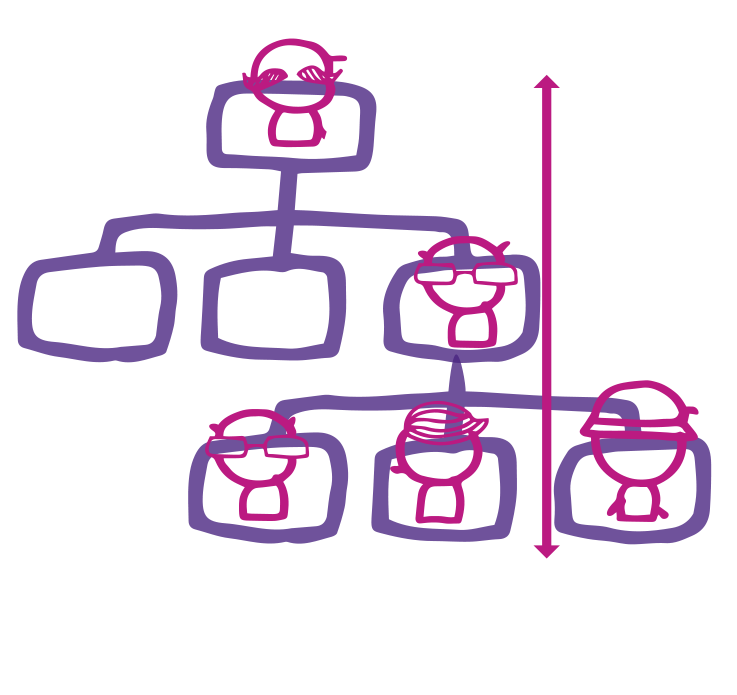
My advice is clear: Change the entire chain of authority, both below AND above the middle manager.
Use the chain to determine the needs of people towards middle management in the new situation. Ask teams what they need from the manager to be successful. Ask senior management what they expect from middle management. This creates both clarity and support.
Coaching
By now it should be clear that thorough coaching is imperative for a smooth transition to a new management style. The most important advice is to take your time. A fast instrumental intervention in which the new management role is determined by others than those that will fulfill it will not work. There’s a famous quote of Peter Drucker called “Culture eats strategy for breakfast”. An instrumental intervention does not change values, beliefs, informal contacts, and habits. And in the end nothing will change because of this. Culture will always be stronger then imposed processes, rules, and procedures. You need to realize that a change of the role of management is nothing less than a change of culture.
Coaching means training and helping the group of managers, but also personal coaching. Coaching also means managers are involved in defining the new management role.
Coaches will have to be external at first. Because who in the organization is totally free of the principles, values, styles, and habits we are trying to change? Even the most enthusiastic pro-change manager has to work within the current context and therefore will be influenced by it. But in the end the force for sustainable change needs to come from inside. It is too important to leave to external coaches. So an important task of external coaches is to create internal champions that support and take over the job of the external coach.
Another advice is to start a buddy system that allows managers to support each other and learn from each other. This contributes to reflection on the new role, and they can help each other in challenging situations that will no doubt arise.
Conclusion
The transformation towards an adaptive organization calls for a fundamental change of the role of management. Because the new role of management differs so much from what has been the standard for decades, it is imperative that coaching and helping management in this transition is taken seriously. Paying attention to the personal motivators of managers is one important step. A clear purpose that managers can align with their personal goals, beliefs, and motivators is another. It is crucial to change the entire management chain, not just middle management. Personal coaching, together with a buddy system, is aimed at creating internal champions. And for those who are not able or willing to transit to the new role the organization should offer a generous exit.
Follow this article
You can choose to follow this article in which case you will be notified when there there are updates of the article. You can also choose to follow all articles of this category. You will then be notified if a new article is added in this category.