
What is engagement?
What is engagement?
Engagement is often misunderstood and oversimplified, but it’s a critical driver of organizational success. In this lesson, we break down what engagement truly means, how it differs from satisfaction and compliance, and why it is essential for adaptive performance management.
You’ll explore the key role of intrinsic motivation in fostering engagement, the pitfalls of relying solely on extrinsic motivation, and the transformative impact of creating a work environment that aligns personal and organizational goals.
Through real-world examples and actionable insights, you’ll learn how to shift from managing tasks to nurturing an engaged and motivated workforce.
What can you expect from this topic?
By the end of this lesson, learners will be able to:
- Define employee engagement and explain how it differs from satisfaction and compliance.
- Distinguish between extrinsic and intrinsic motivation and understand their impact on fostering engagement.
- Identify the manager’s role in creating an environment that aligns employee goals with organizational objectives to drive engagement.
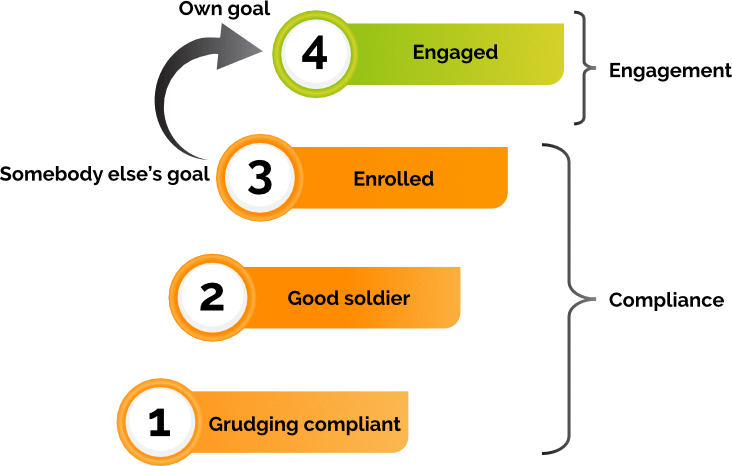
The ladder of compliance
Bibliography
List of notes and sources we reference from.
Notes & Sources
- Gibbons, John. M, Employee Engagement: A review of current literature and its complications, The Conference Board, 2006.
- Adapted from Senge, Peter. (1990). The Fifth Discipline. Random House. Page 203.
- Edward L. Deci, Anja H. Olafsen, Richard M. Ryan, Self-Determination Theory in Work Organizations: The State of a Science, https://pdfs.semanticscholar.org/c1ee/794111e99de40f7143b4270a198278a8525d.pdf?_ga=2.180183852.924176708.1578089050-324802070.157808905