
Rewards and pay
Rewards and pay
Pay plays a unique role in motivating employees. While intrinsic motivation is critical for engagement, pay remains a fundamental component of work life. However, the type and perception of pay can significantly impact performance and motivation. In this lesson, we’ll explore how rewards and pay can either enhance or diminish motivation, the dangers of outcome-based pay, and the importance of fairness and autonomy in compensation strategies. You’ll leave with actionable insights to design pay structures that drive performance without undermining intrinsic motivation.
What can you expect from this topic?
- Understand how different types of pay influence employee performance and motivation.
- Differentiate between performance-based pay, outcome-based pay, and regular salaries in terms of their impact on motivation.
- Recognize the role of fairness and autonomy in creating effective pay structures.
- Explore strategies for aligning pay with organizational values and goals.
[ld_video]
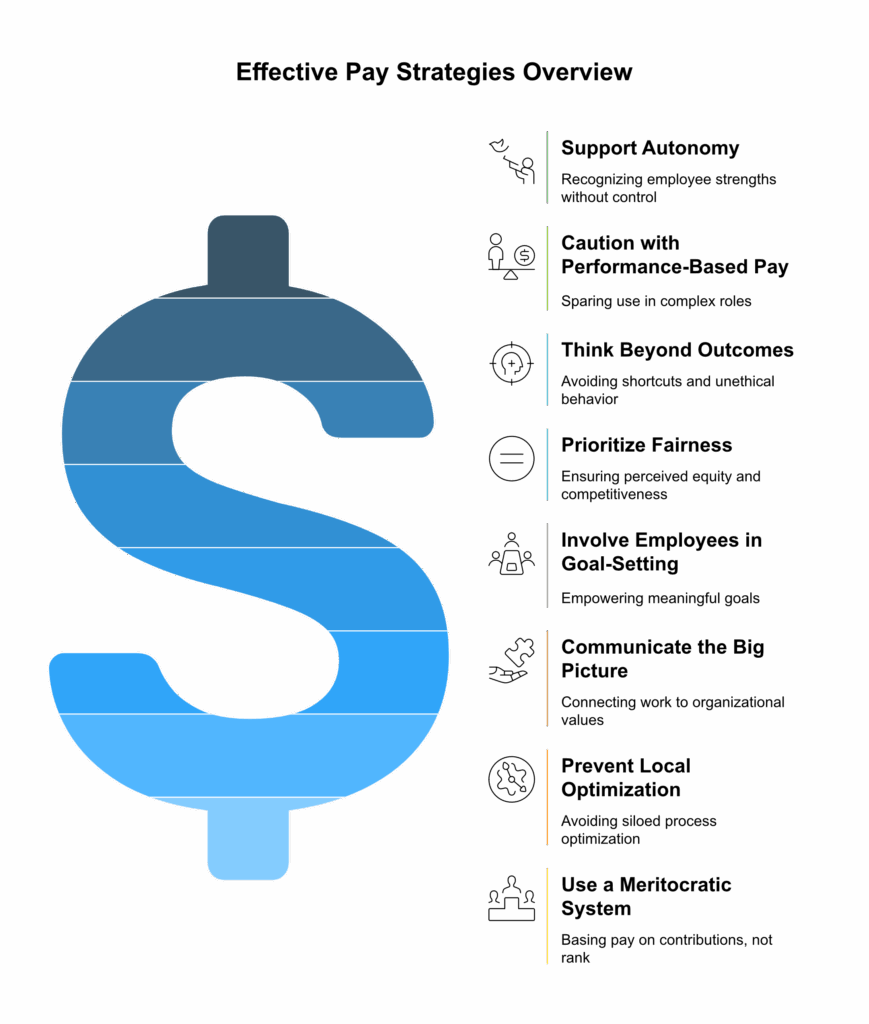
Strategies for a pay system that supports engagement and performance
Bibliography
List of notes and sources we reference from.
Notes & Sources
- Ryan, Richard M. and Deci, Edward L.. (2017). Self-Determination Theory. The Guilford Press.
- Dan Cable, Freek Vermeulen. 2016. Stop Paying Executives for Performance, https://hbr.org/2016/02/stop-paying-executives-for-performance
- Chidiebere Ogbonnaya, Kevin Daniels,Karina Nielsen. 2017. Research: How Incentive Pay Affects Employee Engagement, Satisfaction, and Trust, https://hbr.org/2017/03/research-how-incentive-pay-affects-employee-engagement-satisfaction-and-trust